

Innovation is the lifeblood of Rolex in its eternal pursuit of technical excellence, flawless craftsmanship, and precision timekeeping. At Watches & Wonders 2025, Rolex presented the Oyster Perpetual Land-Dweller, characterized by a restyled Oyster case, striking honeycomb dial pattern, and harmoniously integrated five-piece Jubilee bracelet.

Encapsulating a century’s worth of watchmaking expertise, the Land-Dweller’s foremost innovation is notably its new beating heart: the Calibre 7135, featuring a revolutionary Dynapulse escapement. Skilfully mastered to deliver superlative performance, the Calibre 7135 and its Dynapulse escapement take a completely novel approach in form and function. With no fewer than 32 patent applications and patents to the Land-Dweller’s name, 16 pertaining to the movement, and seven exclusive to the Dynapulse escapement. Setting a future technical standard for Rolex, the Dynapulse escapement is a beautiful but distinctly complex machine. Here’s a technical breakdown, yet a simplified guide to understanding the method behind its mastery.
Friction Is a Foe

Almost every mechanical watch on this planet employs a traditional Swiss lever escapement — the most outdated, inefficient of its kind. It relies on a balance wheel that rocks a pallet fork back and forth, regulating energy flow in the process. However, as time passes, friction is caused by the metronomic cadence of two components striking against each other. This results in the wearing of parts and adversely reduces efficiency. To aid this, watchmakers use lubricants, which unfortunately, also deteriorate over time, and are one of the key reasons why a mechanical watch requires periodic servicing.
The Need for Escapements
Imagine the tap of a water tank — it doesn’t store its contents, but controls it. Similarly, without a calibre’s escapement, the mainspring’s energy would explode, emptying its energy in a matter of moments. If the escapement doesn’t maintain oscillations, the hairspring and balance wheel would rapidly lose their energy — causing the calibre to simply stop ticking after a few minutes. Apart from energy regulation, the escapement and oscillator play strategic roles in determining the precision and reliability of a timepiece’s movement.
Nothing Escapes Rolex
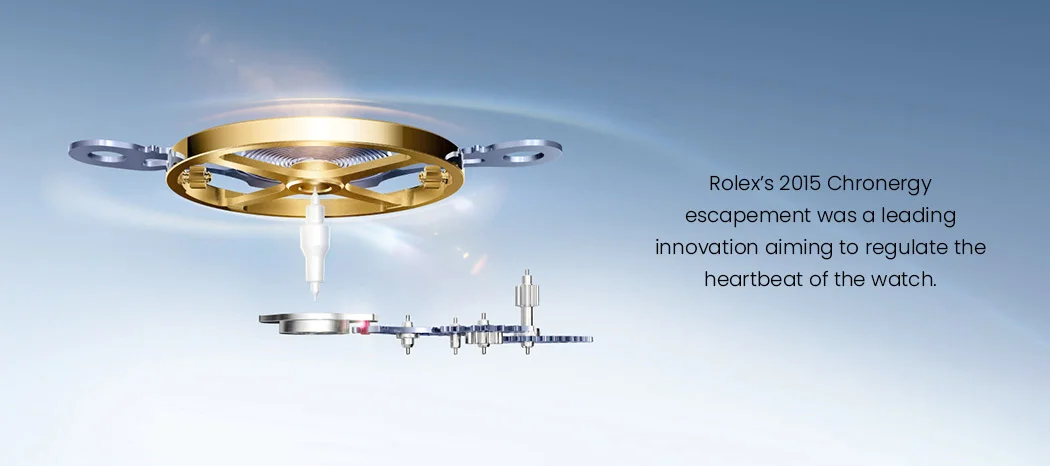
Over the years, the fundamental mechanics of the Swiss lever escapement have been optimized in geometric architecture and choice of materials to achieve more efficient energy escapement. Rolex’s 2015 Chronergy escapement was a leading innovation aiming to regulate the heartbeat of the watch. In a timed dance between two pallets and an anchor, it carefully halted and released the rotation of the dented balanced wheel. This happened eight times per second, delivering 28,800 rounds per hour, 700,000 times a day, and 250 million times a year, resulting in 15% greater efficiency than a standard Swiss lever escapement.
Dynapulse Escapement
The Dynapulse has one mission: energy efficiency. Being the first and most critical component of the regulation system, it’s designed to significantly enhance the energy flow between the barrel and the oscillator. This innovation ensured that the movement’s anatomy remained unchanged, with its performance remaining equal to the Calibre 7140. Simply put, the Dynapulse escapement, which Rolex considers a ‘key to time’, consists of four components: Beginning with a large transmission wheel that engages with smaller two distribution wheels, which ultimately strike against an impulse rocker.
Rolex’s Dynapulse escapement has seven patents to its name in regard to design. Crafted entirely out of silicone, the two distribution wheels have teeth and blades on the same plane, serving a dual function of meshing into each other and piloting the impulse rocker. To ensure the Dynapulse escapement’s functionality, Rolex conducted intensive research into the morphology of each component. This innovative architecture and silicon composition are not only highly resistant to magnetic fields but also reduce the movement’s energy consumption and inertia. The Dynapulse escapement’s unique geometric structure is the result of years of research and development.
Lubrication in Nanolitres
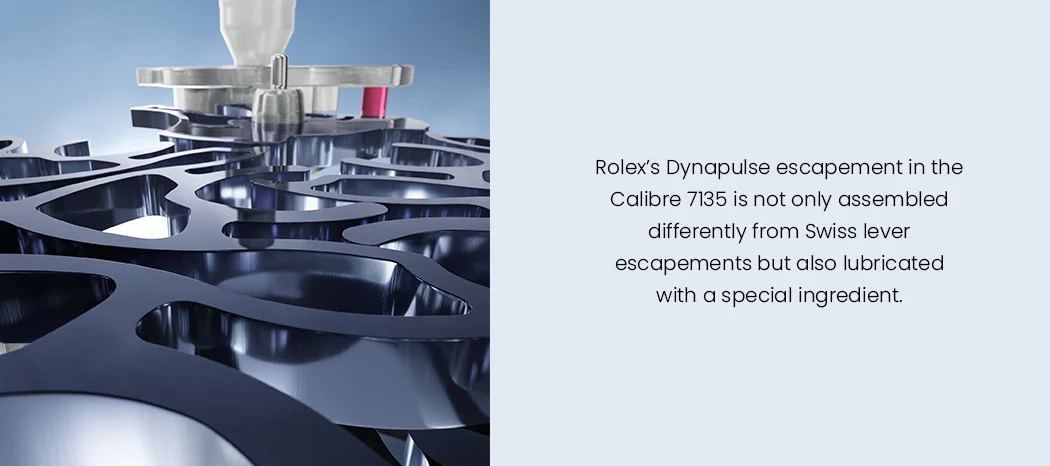
Rolex’s Dynapulse escapement in the Calibre 7135 is not only assembled differently from Swiss lever escapements but also lubricated with a special ingredient. Appropriate lubrication of the escapement is essential for energy regulation optimization. Considering the functionality of an escapement and the temperature variations that occur, Rolex chose oil rather than grease as a lubricating agent. Furthermore, every escape wheel tooth and escape wheel pivot point requires careful lubrication with a precise amount of oil, down to the scale of nanolitres. Applied using a curved precision needle, this delicate and complex task is carried out professionally on an external support, before being inserted into the movement. For Rolex, this is a completely novel and innovative approach, striving to enhance the reliability and performance of the brand’s watches in the long run, with longer intervals between services.
Rolex’s Dynapulse escapement delivers 15% more energy efficiency as compared to traditional Swiss lever escapements, allowing the Calibre 7135 to increase beat rate of 5 Hz at 36,000 vibrations per hour without sacrificing any of the 66 hours of power reserve.



Recent Posts
Recent Comments
Archives